Vietnam Continues to Shine Amid Global Economic Uncertainties
Vietnam’s economic landscape is witnessing remarkable resilience, especially as the world grapples with growing uncertainties. According to the latest World Economic Outlook report by the International Monetary Fund (IMF), Vietnam’s GDP growth is projected to hit an impressive 5.8% in 2023, with an expected acceleration to 6.9% in 2024. This positions Vietnam as one of the fastest-growing economies in the region, a notable feat given the global economic headwinds.
| IMF’s Economic Forecast for Asia |
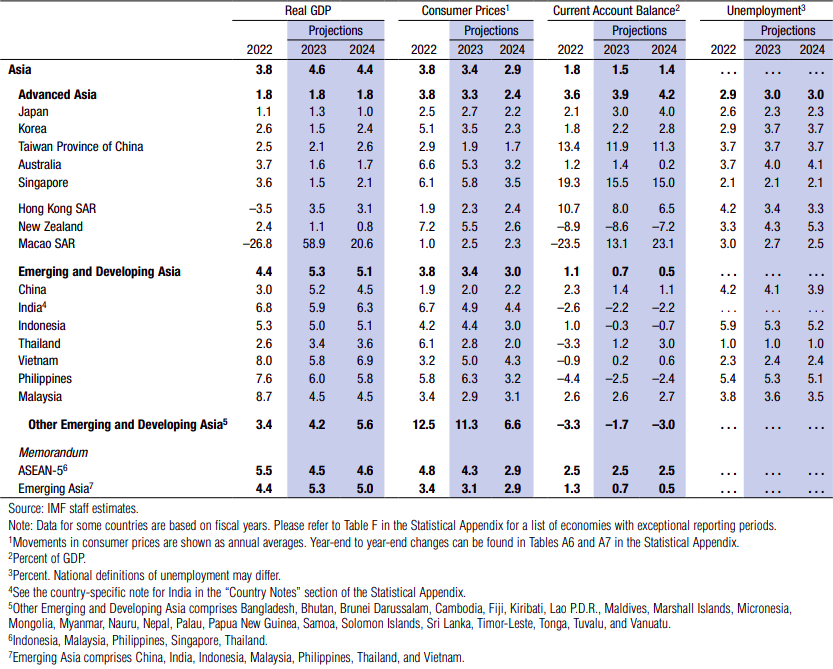

Despite these optimistic figures, the IMF’s forecast remains somewhat conservative compared to other institutions. The World Bank anticipates a higher GDP growth rate of 6.3% for the year, while the Asian Development Bank (ADB) estimates it at 6.5%. Notably, Vietnam’s National Assembly has also set a GDP growth target of 6.5% for 2023, reflecting a consistent vision for economic progress.
### Ranking Among Emerging Economies
Looking at the broader picture, Vietnam’s growth trajectory outpaces most of its regional counterparts. Only India and the Philippines are expected to achieve slightly higher growth rates this year, at 5.9% and 6% respectively. However, projections for 2024 indicate that Vietnam will leap ahead with a GDP growth rate of 6.9%, outpacing India’s forecast of 6.3% and the Philippines’ anticipated 5.8%.
### Inflation Trends
While the growth numbers are encouraging, the IMF also forecasts an increase in Vietnam’s inflation rate, projected to rise from 3.2% last year to around 5% in 2023, settling at approximately 4.3% in 2024. This inflationary trend underscores the complexities facing domestic and global economies alike and serves as a reminder for policymakers to navigate carefully.
### The Global Economic Context
On a global scale, the IMF’s report paints a more somber picture. Despite some signs of a soft landing for the global economy—characterized by falling inflation and steady growth—these have been overshadowed by persistent inflation and turmoil in the financial sector. Central banks have responded to inflation by raising interest rates, yet underlying price pressures remain, particularly in labor markets across several economies.
The repercussions of rising policy rates are becoming increasingly evident, revealing vulnerabilities within the banking sector and raising concerns about potential contagion effects. High debt levels further complicate matters, constraining fiscal policymakers’ abilities to respond effectively to emerging challenges.
### Ongoing Global Challenges
The conflict in Ukraine continues to exert its influence on commodity prices, which had previously surged. While prices have moderated, geopolitical tensions remain high, adding another layer of complexity to the global economic landscape.
As various economies recover from the disruptions caused by Covid-19, particularly in hard-hit regions like China, supply chain stability is improving. However, the global outlook still harbors significant downside risks, especially in light of recent financial instability.
The IMF’s baseline forecast suggests a decline in global growth from 3.4% in 2022 to 2.8% in 2023, with a slow recovery projected at around 3% over the next five years—marking the lowest medium-term forecasts in decades. In a more pessimistic scenario characterized by deeper financial sector stress, growth could plummet to approximately 2.5% in 2023—the weakest growth rate since the early 2000s, excluding the crises in 2008 and 2020.
### Conclusion (Left for Further Exploration)
Through these various lenses, Vietnam’s ascent shines brightly, showcasing its potential as a beacon of growth amid global economic challenges. The evolving dynamics present opportunities and hurdles alike, making the future of Vietnam’s economy a topic worthy of keen observation.