
By
Tri Duc
Fri, October 11, 2024 | 11:02 am GMT+7
In an exciting development for infrastructure projects in Vietnam, the China-based Asian Infrastructure Investment Bank (AIIB) and the Vietnamese government have reached an agreement to enhance cooperation as part of China’s Belt and Road Initiative (BRI) and Vietnam’s Two Corridors, One Belt framework.
Vietnamese Prime Minister Pham Minh Chinh and AIIB President Jin Liqun made this commitment during a meeting that took place on the sidelines of the recent ASEAN Summits held in Laos. This gathering served as a vital platform for discussing infrastructure development, which is crucial for Vietnam’s economic future.
Both parties agreed to form working groups that will conduct pre-feasibility studies for several key infrastructure projects aimed at improving connectivity between Vietnam and China. This collaboration is seen as a significant stride toward enhancing Vietnam’s logistics capabilities and infrastructure.
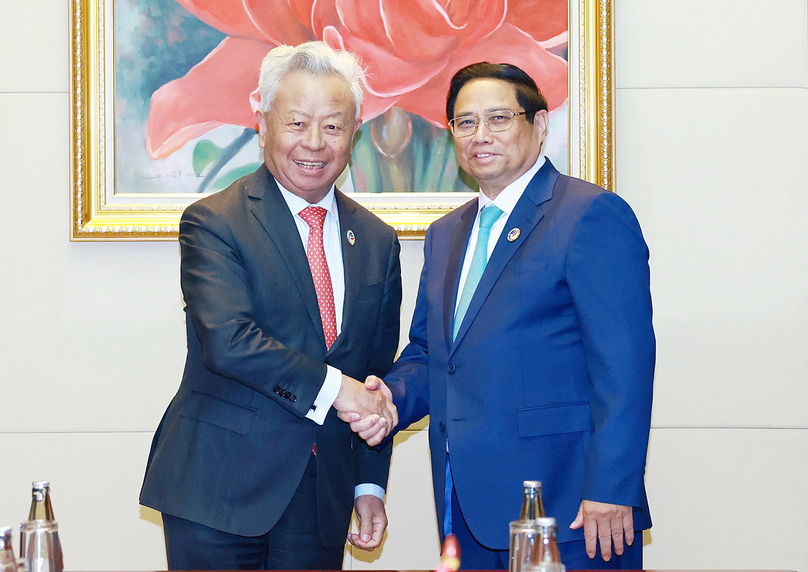
Vietnamese Prime Minister Pham Minh Chinh (right) and AIIB president Jin Liqun at a meeting in Vientiane, Laos, October 10, 2024. Photo courtesy of the government’s news portal.
During the meeting, PM Chinh emphasized the importance of developing Vietnam’s road and rail infrastructure. He urged the AIIB to facilitate mobilization of resources for major projects, including the Lao Cai-Hanoi-Hai Phong and Lang Son-Hanoi standard-gauge railways. These projects are expected to improve transportation efficiency and support economic development in the region.
Additionally, PM Chinh suggested that the AIIB could offer preferential loans, technology transfer, and assistance in training human resources essential for the successful implementation of these major projects.
The identified projects under consideration include Lao Cai-Hanoi-Hai Phong, Mong Cai-Ha Long-Hai Phong, and Lang Son-Hanoi railways, all of which are vital links under the BRI framework intended to strengthen ties between Vietnam and China.
Agreeing with the proposals put forward by Chinh, Jin Liqun acknowledged the potential of major infrastructure initiatives to significantly enhance Vietnam’s logistics sector and attract high-quality foreign investment. He assured that the AIIB is committed to collaborating closely with Vietnam to mobilize the necessary resources for these transformative infrastructure projects. This includes a focus on developing high-speed railway systems and engaging in projects related to climate change adaptation and energy transition in the Mekong subregion.
Vietnam Seeks WB Loans for Major Traffic Infrastructure Projects
On the same day, PM Pham Minh Chinh also met with Manuela V. Ferro, the vice president for East Asia and the Pacific at the World Bank Group. In this discussion, he sought the World Bank’s continued support through preferential loans aimed at facilitating significant projects, including high-speed rail, urban rail (metro), seaports, and airports across Vietnam.
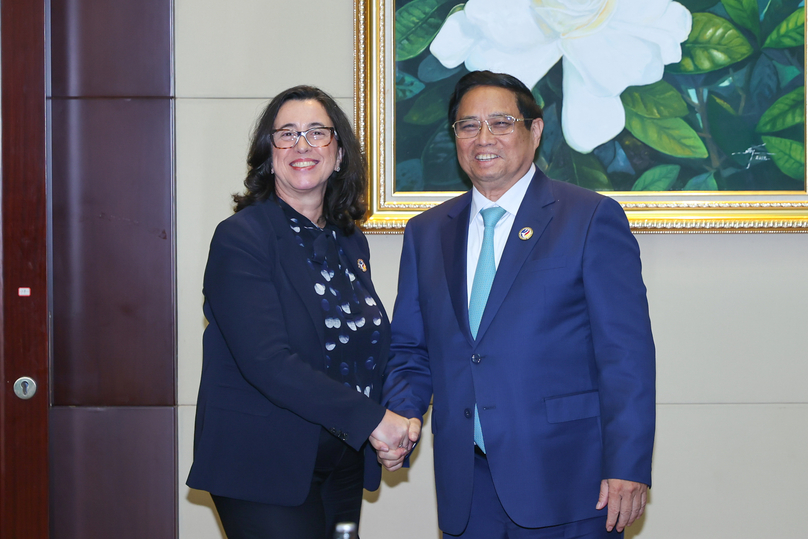
Vietnamese Prime Minister Pham Minh Chinh (right) and Manuela V. Ferro, vice president, East Asia and Pacific, at the World Bank, at a meeting in Vientiane, Laos, October 10, 2024. Photo courtesy of the government’s news portal.
Ferro responded positively to Chinh’s proposals, emphasizing the World Bank’s commitment to support Vietnam’s aspirations to become a developed nation by 2045. She also underscored the importance of helping Vietnam integrate further into global supply chains and attract high-quality investments.
The meeting concluded with an agreement to update the administrative procedures for loans, ensuring a streamlined and efficient deployment of infrastructure projects aimed at boosting Vietnam’s economic growth.
Vietnam Seeks Preferential Loans from South Korea for High-Speed Railway Project
In another significant discussion during the ASEAN Summits, PM Pham Minh Chinh met with South Korean President Yoon Suk-yeol. Chinh reaffirmed Vietnam’s commitment to facilitating long-term operations of South Korean businesses in the country.
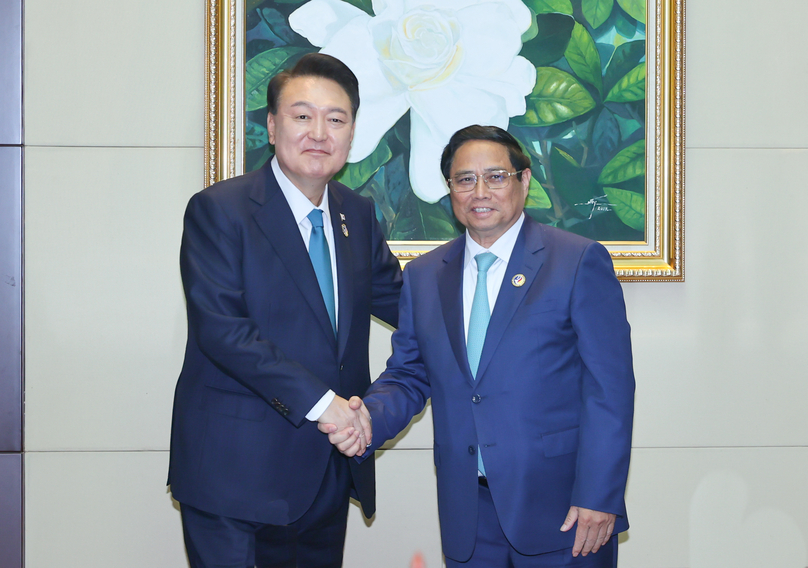
Vietnamese Prime Minister Pham Minh Chinh (right) and South Korean President Yoon Suk-yeol at a meeting in Vientiane, Laos, October 10, 2024. Photo courtesy of the government’s news portal.
He urged South Korea to consider providing preferential loans for crucial infrastructure projects, including a high-speed railway and expressway. Chinh also appealed for South Korean support in training young Vietnamese professionals, aligning with a South Korean initiative for talent development within ASEAN countries.
In response, President Yoon Suk-yeol emphasized South Korea’s eagerness to enhance collaboration with Vietnam across various sectors, including infrastructure, energy, urban development, and liquefied natural gas (LNG).