
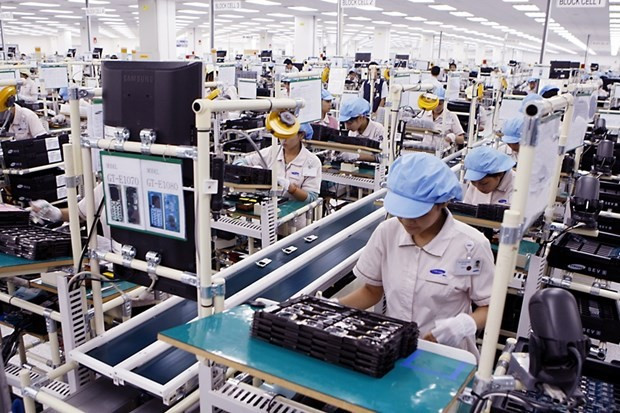
An electronics component manufacturing and assembly line. (Photo: VNA)
After more than a decade of robust expansion, Vietnam’s electrical and electronics (E&E) industry is approaching a critical juncture, with growing momentum to move past its traditional role as an assembly base and secure a stronger foothold in global value chains.
An Electronics Manufacturing Powerhouse
In the last ten years, the E&E sector has emerged as one of Vietnam’s most vibrant growth drivers, attracting substantial foreign direct investment (FDI) from numerous multinational giants. This influx has not only bolstered the economy but also integrated domestic companies into global supply chains, enhancing local manufacturing capabilities significantly.
With investments pouring in—amounting to tens of billions of US dollars—Vietnam’s production and export potential is on an exponential rise. Notably, Samsung, the largest foreign investor in the country, has cultivated a network of over 300 Vietnamese suppliers, showcasing a success story of local engagement.
According to Cho Sang Jae, Director of the Korea Trade-Investment Promotion Agency (KOTRA) in Hanoi, Vietnam’s journey in electronics manufacturing has seen a commendable shift. The nation is gradually transitioning away from simple assembly-based production, a move that is pivotal for sustaining long-term growth.
Electronics exports have skyrocketed, with turnover leaping from nearly 46 billion USD in 2015 to an anticipated 126.5 billion USD in 2024. By November 2025, exports are projected to approach 150 billion USD, accounting for about one-third of the country’s total export value—more than tripling the figures from just ten years ago. This remarkable growth places Vietnam among the top ten electronics exporters globally, solidifying its status as a strategic manufacturing hub for multinational corporations in the region.
Despite these achievements, the sector grapples with structural challenges. Supply chains are notably fragmented, and comprehensive data covering various components, assembly processes, logistics, testing, and research and development is still scarce.
Even with exports nearing 150 billion USD, the year-on-year import figures for electronics parts, computers, and components surged by 39.2%, reaching 136 billion USD. This imbalance highlights a persistent reliance on foreign imports, particularly in high-value segments, undermining the industry’s overall capabilities.
The position of domestic firms largely remains confined to lower value-added segments. The current rate of locally produced components is still modest, pointing to a heavy dependency on imported materials and core components.
Moreover, information gaps between Vietnamese enterprises and FDI firms hinder effective partnerships. Local firms often lack access to reliable data necessary for strategic decisions. Additionally, authorities and investment promotion agencies face challenges in distinctly identifying gaps within the value chain due to insufficient data tools.
New Momentum from a Value Chain Map
In response to these challenges, the Vietnam Trade Promotion Agency, in collaboration with KOTRA, has unveiled the Vietnam E&E Value Chain Map. This initiative is accompanied by a comprehensive enterprise directory aimed at facilitating connections and partnerships within the industry.
Cho Sang Jae emphasizes that Vietnam is progressively fostering a more advanced manufacturing ecosystem covering significant areas, including computers, household appliances, industrial equipment, automotive components, renewable energy systems, medical devices, and lighting products.
While several global corporations have firmly established their presence in Vietnam, many small-to-medium enterprises and mid-sized foreign firms remain hesitant. This reluctance largely stems from their limited access to reliable local market insights and supply chain information.
The newly released value chain map strives to enhance transparency across the entire E&E supply chain, which generates hundreds of billions of US dollars each year. It identifies what products are manufactured, the segments involved, and their respective capacities, ultimately facilitating a clearer understanding of missing links and prioritizing investment needs for sustainable growth.
KOTRA asserts that this initiative extends beyond mere data collection; it serves as a critical strategic information infrastructure to support trade promotion, attract investments, and bolster Vietnam’s industrial development and national competitiveness. For policymakers, it lays a crucial groundwork for targeting investments that can strengthen supply chains and elevate Vietnam’s global standing in the E&E sector.
Looking ahead, experts agree that it is imperative for Vietnam to ensure that FDI not only translates into technology transfer but also fosters the growth of domestic enterprises, avoiding the pitfalls of an “assembly trap.” Key strategies may involve establishing joint research centers, encouraging collaboration between multinational firms and local businesses, providing incentives tied to the rates of locally produced components, and developing a technically skilled workforce through enhanced cooperation between educational institutions and industry.