
Student accommodation is evolving rapidly in the Czech Republic and across Europe, reflecting shifting demographics, education landscapes, and investment opportunities. With more than 315,000 university students in the Czech Republic—including over 56,000 international students—there’s a noticeable strain on housing capacity. In Prague alone, nearly three students compete for each available bed, underscoring a significant housing shortage. Reports by real estate consultancy Cushman & Wakefield affirm that the demand for student housing currently far outweighs the supply, leading to escalating prices and pronounced regional disparities.
Europe: A Student Housing Market in Transition
Throughout Europe, student accommodation has emerged as a pivotal topic in the real estate sector, garnering increasing interest from investors. Purpose-built student housing is viewed as a promising avenue within the broader living sector. Several factors fuel this enthusiasm: a growing number of young people pursuing higher education, heightened international student mobility, and evolving demographic trends are reshaping housing demand. However, the supply of adequate student accommodation is not keeping pace, leading many students to contend for limited options. This competition drives up rental prices, elevating the importance of quality and availability. Furthermore, the construction of new facilities faces hurdles, including recent global events and rising building costs. Despite these challenges, investor confidence in the sector remains robust, with expectations for continued growth and capital attraction.
Czech Republic: Stable Student Numbers, Capacity Shortages, and Regional Differences
The situation in the Czech Republic regarding student accommodation is becoming increasingly critical. With over 315,000 students enrolled at Czech universities, the lack of adequate housing options is starkly apparent. While student numbers have seen a moderate annual increase of just 1% over the past five years, significant regional disparities exist. For instance, Prague continues to stabilize its growth trajectory, while cities like Brno and Ostrava are still recuperating from previous declines. In Brno, student enrollment dropped from over 75,000 in 2010 to about 63,000 in 2024—a telling sign of the shifting educational landscape.
The availability of student accommodation in these major cities has failed to match the surging demand. Cushman & Wakefield’s comprehensive analysis reveals a limited supply, with prices fluctuating by region and type of provider. In 2024, there are 165 facilities providing student accommodation across the country, yielding a total of 67,863 beds. The public sector boasts 60,219 beds, while private providers account for only 7,644 (about 11%). The biggest amenities are concentrated in major urban centers: Prague (28,067 beds), Brno (13,672), and Olomouc (4,907).
Leading public providers include Charles University with 10,829 beds and Czech Technical University with 7,567 beds. In contrast, the private sector is led by CPI Hotels (1,761 beds) and Karlín Group & International Campus (675 beds). Many of these facilities are in dire need of renovation or substantial capital investments.
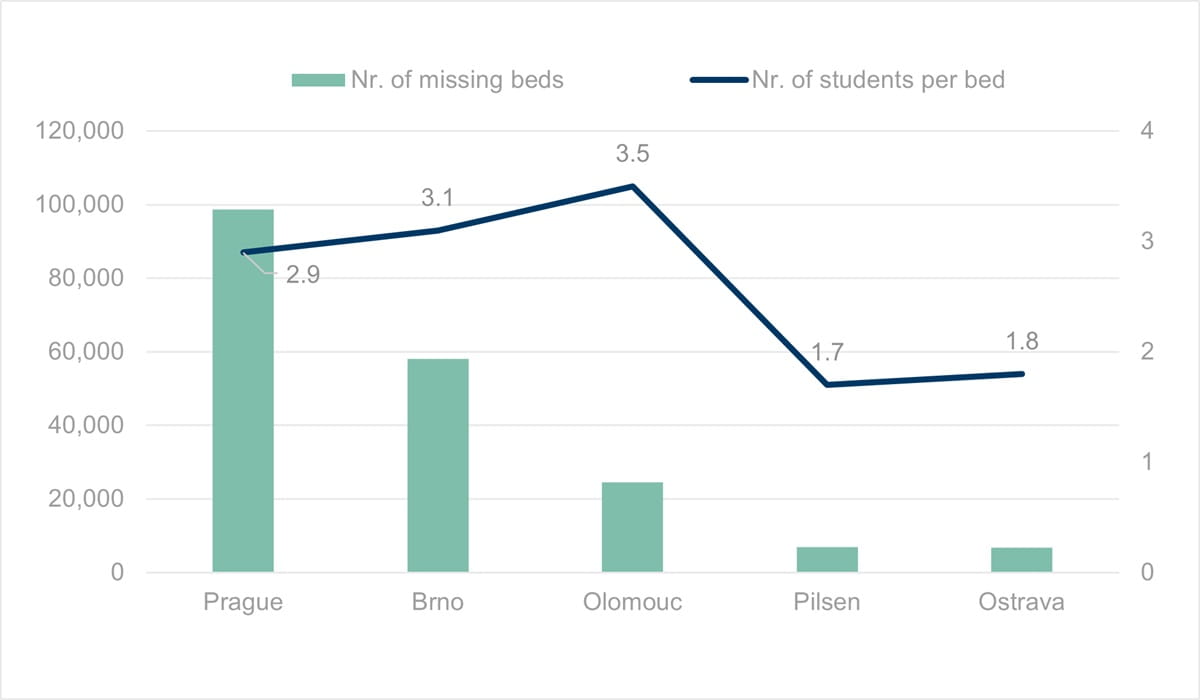
According to Cushman & Wakefield, the student-to-bed ratio in Prague is 2.9 students per available bed, while in Olomouc, this ratio is even higher at 3.5. Such figures reveal the limited accommodation options available, particularly in key university cities.
Kamila Breen, Head of Research, Cushman & Wakefield: “The Czech student housing market is facing a critical capacity shortage. Universities currently offer fewer than 68,000 beds, while there are over 315,000 students. In Prague, nearly three students compete for a single bed, and similarly unfavorable ratios are reported in other university cities, driving up dormitory prices. However, this situation also presents a major opportunity for investors.”
Graph 1: Shortage of beds in major university cities in the Czech Republic
Source: Cushman & Wakefield
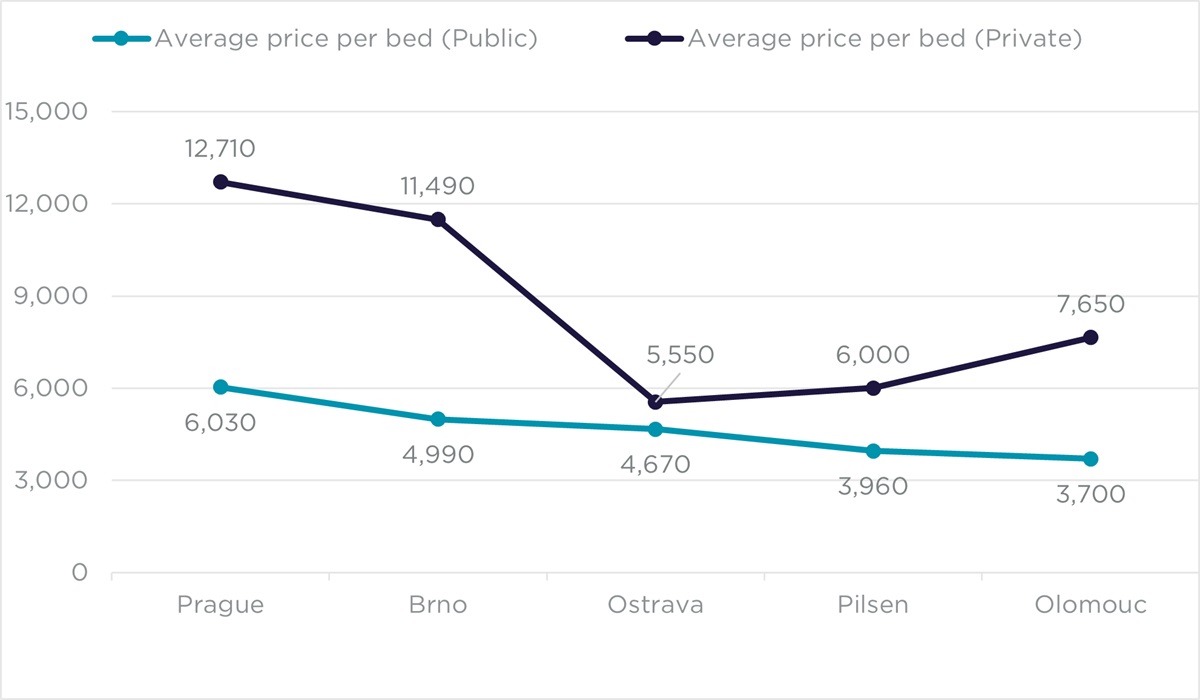
Accommodation costs vary considerably by region and provider type. In Prague, the average price in the public sector is approximately 6,030 CZK per bed per month, while private sector prices soar to an average of 12,710 CZK per bed per month. In contrast, regional accommodation prices tend to be lower, with public options averaging 4,610 CZK per bed per month and private accommodations at about 8,790 CZK.
Graph 2: Average Price in Selected Cities in the Czech Republic – (CZK per bed per month)
Source: Cushman & Wakefield
Challenges and Opportunities Ahead
Availability and quality of student housing significantly impact university life, influencing student comfort and the overall appeal of cities and educational institutions. The Czech Republic’s student housing market is grappling with pressing capacity shortages, rising prices, and regional disparities. Nevertheless, this scenario opens the door to new investments, innovative solutions, and the much-needed development of high-quality student housing.
Alina Cazachevici, Head of Valuation & Advisory, Hospitality & Alternatives, CEE & SEE: “Student housing represents a strong investment opportunity in the Czech Republic, especially in key cities, due to strong demand and limited supply growth. Part of the current offering is outdated and requires significant capital investment. This creates opportunities for investors to capture the demand for modern, high-quality student accommodation.”