National Transport Infrastructure Makes Great Strides
In recent years, Vietnam’s national transport infrastructure system has made remarkable strides, showcasing robust and synchronized development. By the end of 2025, the completion of key projects has led to the operationalization of impressive lengths of transport routes—including 3,345 km of main expressway routes and 458 km of interchanges and access roads. Additionally, the nation has seen the opening of 1,701 km of coastal roads and 1,584 km of national highways, all of which are crucial for enhancing the country’s connectivity.
Van Ninh – Cam Lo Expressway is among the sub-projects of the North–South Expressway (Eastern section) project (Photo: VNA)Panoramic view of Cai Mep – Thi Vai port complex in Ho Chi Minh City (Photo: VNA)
Furthermore, significant upgrades and expansions are underway in airports, major seaports, and railway infrastructure. Notable completions include Terminal T2 at Noi Bai International Airport in Hanoi and Terminal T3 at Tan Son Nhat International Airport in Ho Chi Minh City. Ongoing developments include Long Thanh, Gia Binh, and Phu Quoc airports, which are set to bolster the nation’s air travel infrastructure. National railway projects are also advancing, encompassing the North–South High-Speed Railway and additional key routes connecting major cities.
The urban landscape in Vietnam has witnessed faster development, which is increasingly meeting the needs of both residents and businesses alike. As urban areas expand, new urbanized zones and growth centers emerge, alongside the development of economic zones, industrial parks, and tourist-service complexes. Essential utilities such as power, water supply, and drainage systems are being upgraded to accommodate these changes.
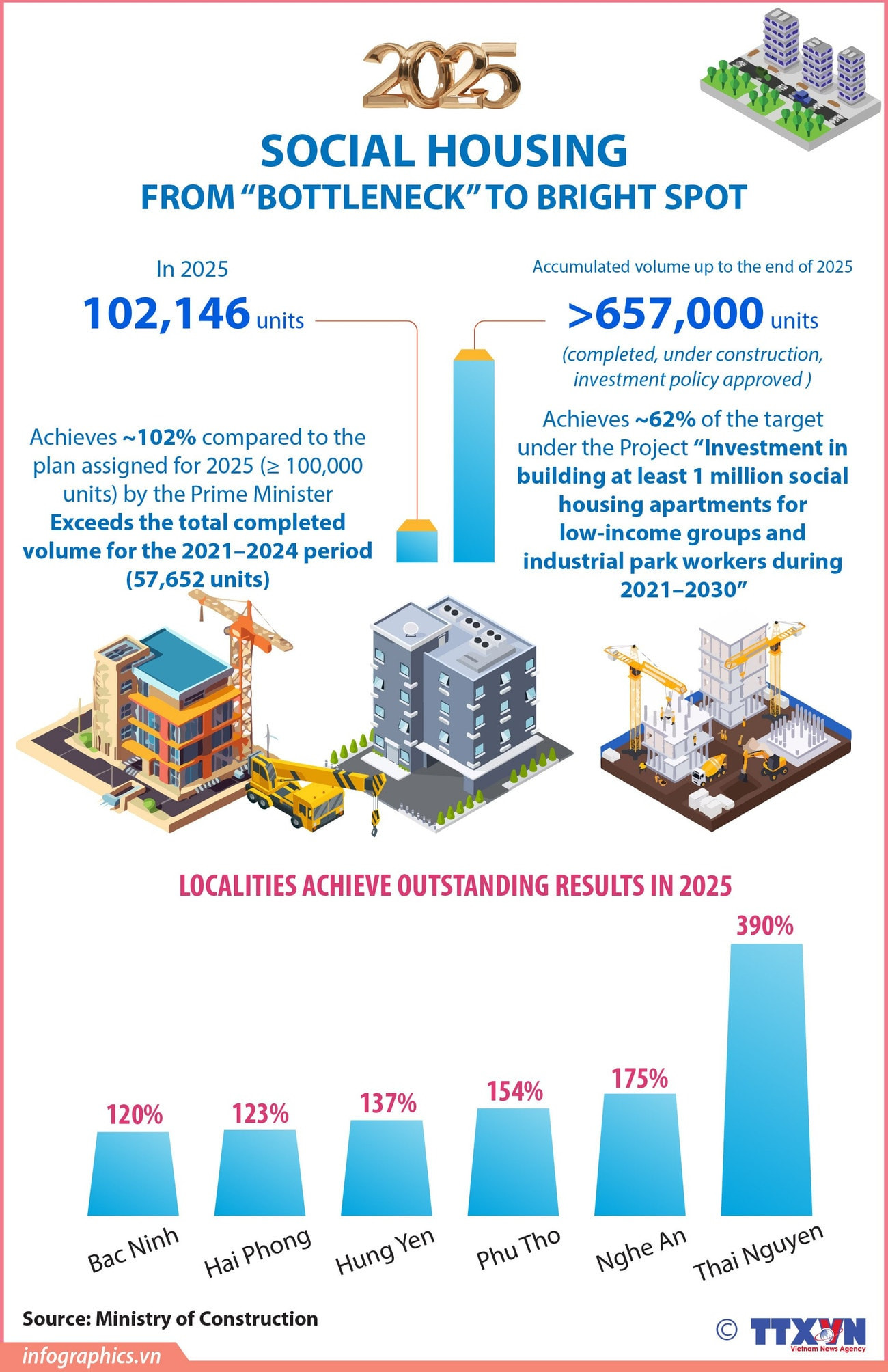
Important social initiatives, including housing programs for workers and urban renovation projects, aim to elevate living conditions throughout the country. Over 687,000 social housing units have been constructed, and 334,200 outdated houses have been replaced, reflecting the government’s commitment to improving the living standards of its citizens.
The energy sector in Vietnam has experienced significant growth, positioning the country as a leader in Southeast Asia in terms of power system scale. By the end of 2025, the total installed capacity of the national power system—excluding imported electricity—reached approximately 87,600 MW, an increase of nearly 6,400 MW since 2024. Notably, renewable energy sources, including wind, solar, and biomass, accounted for around 24,453 MW, making up approximately 27.9% of the total capacity.
National Digital Infrastructure Records Breakthroughs
In the realm of telecommunications, Vietnam’s internet speed has soared, placing it among the leading nations in the region and ranking within the global top 10-15—according to international assessments. With 4G coverage surpassing 99.8% and 5G servicing over 91% of the population, the nation has achieved comprehensive connectivity, with every commune and ward now connected by fibre-optic broadband. About 87.6% of households are covered by fibre networks, and smartphone penetration is estimated at over 85%.
Innovation capacity and the startup ecosystem in Vietnam have significantly strengthened, enhancing the country’s competitiveness. Vietnam ranked 44th among 139 economies in the 2025 Global Innovation Index (GII) released by the World Intellectual Property Organization (WIPO), marking it as one of only nine middle-income economies with a rapid improvement in rankings over the last decade.
By 2025, nearly 78% of applications for fully online public services were submitted end-to-end via digital platforms, with close to 84% of public services generating online applications.
These figures signify that Vietnam has transitioned from basic digitalization towards a model of “data-driven operations.” This digital infrastructure serves as a cornerstone for enhancing governance effectiveness and reducing costs for citizens and businesses alike.
Strong Breakthroughs in Synchronised, Modern Infrastructure
In the past five years, an impressive array of large-scale, modern, and well-coordinated projects in areas such as transport, energy, logistics, urban development, healthcare, education, and digital infrastructure have either been completed or are currently underway. These initiatives are already generating significant spillover effects, enhancing land values, boosting competitiveness, and making Vietnam a vital connectivity hub both regionally and globally.
As reported by the 13th Party Central Committee, the emphasis on three strategic breakthroughs—crucial for achieving the country’s developmental goals—places infrastructure development alongside institutional reform and the cultivation of high-quality human resources.
Significantly, the report emphasizes not just transport, energy, and urban infrastructure, but also digital and data infrastructure—key elements underpinning the digital economy and modern governance. There is a clear prioritization of “strategic transport infrastructure, energy infrastructure, urban infrastructure, telecommunications infrastructure, particularly focusing on digital and data infrastructure.”
The Party leader expressed the importance of aligning infrastructure development with climate change adaptation and enhancing regional connections. He emphasized that expanding development space in accordance with the national master plan is essential, ensuring both regional and local connectivity while promoting integration on regional and global scales. Strengthening connectivity is vital for reducing logistics costs, improving investment efficiency, and expanding market opportunities—all while creating jobs and fostering widespread development nationwide.
The report delineates three strategic breakthroughs meant to be pursued with urgency and commitment: systems that pave the way, human resources that determine speed and quality, and infrastructure that creates space and momentum for sustained growth.
“By implementing these strategies cohesively, we can generate new momentum and a stronger developmental position; half-hearted efforts, however, may lead to missed opportunities,” the Party leader warned.
As the country stands on the brink of a significant era in its developmental journey, institutions are becoming increasingly recognized as the “breakthrough of breakthroughs.” The youthful workforce is eager to contribute to this growth, and rapid advancements in national digital infrastructure are paving the way for a new future. All these factors are set to converge under the dynamic strategies laid out for the nation’s next phase of prosperity.