
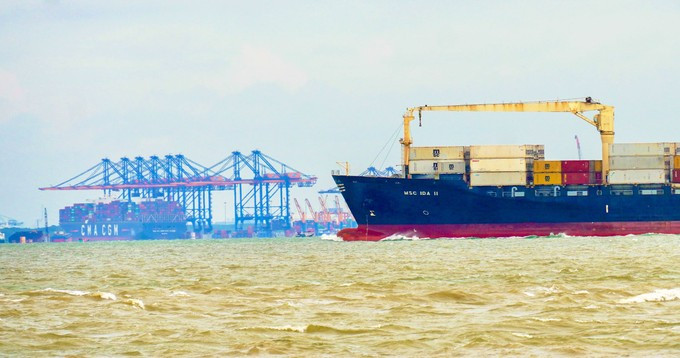
Reducing logistics expenses in maritime transport is paramount, necessitating proactive measures from businesses as well as active engagement from regulatory agencies. The dynamic nature of sea freight rates poses a significant challenge, with various factors influencing costs and market conditions.
Sea Freight Rate Prediction Challenges
The Vietnam Maritime Administration (VMA) reports that international container shipping rates peaked in September 2021, primarily due to disruptions caused by the Covid-19 pandemic, which led to extensive supply chain congestion. By the end of 2023, freight rates had gradually declined to levels reminiscent of the pre-pandemic era. However, a surge in these rates was noted at the start of 2024, particularly for routes to Europe and America, prompted by conflicts in the Red Sea region.
The rerouting of cargo ships around the Cape of Good Hope extended shipping times by ten to fourteen days, causing freight rates to double compared to the end of 2023 levels. As of early March 2024, rates had decreased by approximately 29 percent from January’s peak but were still 53 percent above rates from the previous year.
Forecasting these rates remains a complex endeavor, heavily influenced by international market dynamics. With 80-90 percent of goods shipped under buy-CIF-sell-FOB agreements—where Vietnamese companies merely deliver goods to the port—the actual hiring of vessels and payment of freight rates is mainly handled by foreign partners. This arrangement places small customers, particularly those with short-term contracts, at a heightened risk of being adversely impacted by rising freight rates.
On the other hand, long-term contracts can offer some stability, as rates are less susceptible to fluctuations during the contract period. The VMA anticipates varied and complex changes in the maritime transport market resulting from ongoing armed conflicts, pushing import-export enterprises to adopt proactive strategies for production and planning.
The Role of Foreign Shipping Companies in Vietnam
Currently, 38 foreign shipping companies dominate Vietnam’s container transport services, managing over 90 percent of the country’s import-export cargo volume. Among them, ten major shipping lines are responsible for long-distance transport to the Americas and Europe. Notably, many of these foreign companies operate as wholly foreign-owned enterprises, acting on behalf of their parent shipping lines to facilitate business and provide agency services in Vietnam.
Amid concerns of pressure from shipping lines on Vietnamese shippers, Ms. Nguyen Thi Thuong, Head of the Transport and Maritime Services Department at the VMA, emphasizes Vietnam’s position as the third-largest market in the region—behind Singapore and Malaysia—regarding cargo volumes. This significant market presence ensures that shipping lines are cautious about exerting undue pressure. In fact, sea freight rates are standardized globally, with uniform surcharges applied at seaports, indicating that current rates in Vietnam are competitive compared to the region.
Challenges of Transparency in Freight Rates and Surcharges
While sea freight rate fluctuations mostly burden smaller-scale shippers, all Vietnamese shippers face challenges imposed by service surcharges from shipping lines. Mr. Nguyen Hoang Anh, Secretary of the Vietnam Ship Agents, Brokers, and Maritime Services Providers Association (Visaba), notes that foreign shipping lines typically apply around ten types of surcharges on cargo during loading or unloading at ports. The container handling fee stands out as the most significant among these surcharges, uniformly applicable to both export and import cargo.
Mr. Phan Thong, Secretary-General of the Vietnam Shippers’ Council, highlights how sudden changes in port handling surcharges have adversely impacted shippers. For instance, the enactment of Circular No. 39/2023/TT-BGTVT, which adjusted container handling fees by roughly 10 percent, coincided with a tripling of surcharges by shipping lines compared to the revised loading and unloading fees, leading to considerable financial setbacks for shippers.
Presently, container handling service fees have escalated by approximately 4-20 percent, with costs ranging from USD 120 to USD 155 for a 20-foot container and USD 180 to USD 220 for a 40-foot container. Director Le Do Muoi from the VMA identifies significant shortcomings in the management of freight rates and surcharges, noting that shipping lines often list freight rates at inflated levels to align with pricing regulations, while actual rates remain undisclosed due to business confidentiality concerns.
Moreover, the listing of surcharges often lacks transparency, omitting crucial details such as start and end times, justifications for collection, and records of changes. With Vietnamese shippers typically not involved in negotiating transportation contracts, they frequently find themselves obliged to accept terms dictated by shipping lines. Furthermore, the absence of registered or declared surcharge prices complicates control measures. Consequently, a more robust management framework is deemed necessary beyond the existing pricing disclosure system.
The VMA collaborates with relevant agencies, including the Import-Export Department of the Ministry of Industry and Trade and the Price Management Department of the Ministry of Finance, to engage with shipping lines regarding the recent surge in sea freight rates. Furthermore, the VMA is actively working alongside shipping lines and associated organizations to explore viable solutions for managing freight rate escalations. Shipping lines have committed to reviewing container loading and unloading surcharge prices to ensure more appropriate adjustments.
Ms. Nguyen Thi Thuong also highlighted an essential solution for reducing maritime logistics costs—implementation of the Law on Price 2023, effective July 1, 2024. This new legislation will guide the Ministry of Finance in drafting decrees that include shipping line surcharges for container shipments. Under this framework, shipping lines will be required to declare their surcharges to management authorities, with any price adjustments needing justification and appropriate reporting.
Understanding Various Surcharges for Goods
Numerous surcharges apply to both imported and exported goods. Exported goods typically incur charges such as container loading and unloading fees, documentation fees, sealing charges, and customs declarations (specifically for shipments headed to the US and Europe). When it comes to imported goods, they face charges for container loading and unloading, container cleaning, container imbalance, and telex releases.
The largest component within these charges remains container loading and unloading fees. Additional fees may also be levied for container imbalance, repairs, and declarations related to cargo tonnage. Various surcharges that may be applied irregularly or seasonally include port congestion surcharges, fuel surcharges, and peak season surcharges.
Vietnam’s Top Seaports for Container Throughput
Vietnam is home to three seaports ranked among the top 50 globally for container throughput: Ho Chi Minh City Port, Hai Phong Port, and Cai Mep – Thi Vai Port. In terms of shipping routes, Hai Phong Port services 69 intra-Asia routes, along with two US-Asia and one Asia-Europe routes. The port cluster at Ho Chi Minh City operates 106 intra-Asia routes and one US-Asia and two Asia-Europe routes. Meanwhile, the Ba Ria – Vung Tau port cluster manages nine intra-Asia routes, 21 US-Asia routes, and five Asia-Europe routes.
SGGP