
By
Nguyen Tuong, Bach Quang
Fri, August 12, 2022 | 3:09 pm GMT+7
An urban-industrial symbiosis when developing industrial parks to make them sustainable with good living and working environments for workers will become a trend in Vietnam, experts say.
The government’s Decree 35 on management of industrial zones and industrial parks, dated May 28, 2022, mentions a new form of industrial parks that combines factories and urban living.
Experts expressed their views at the “Vietnam Industrial Park Forum 2022,” held in Ho Chi Minh City by The Investor on a Thursday. They highlighted that these parks, which include industrial real estate, research and development centers, and urban features like entertainment, medical care, education, and residential areas, are likely to dominate future development.
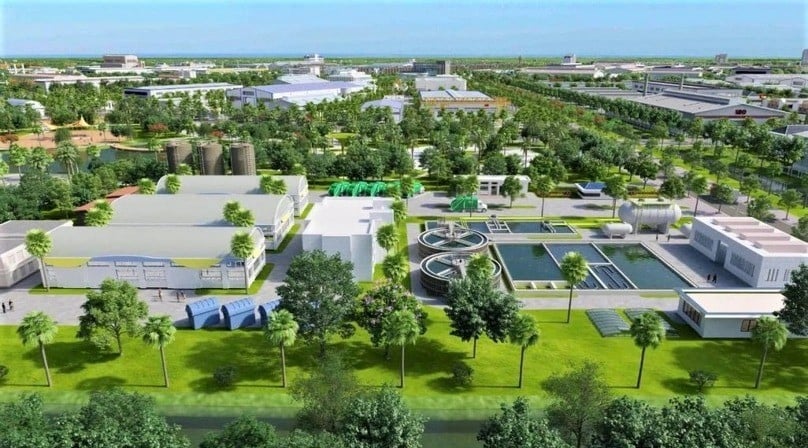
An artist’s impression of Tran Anh Tan Phu Industrial Park in Long An province, southern Vietnam. Photo courtesy of the IP.
Ho Chi Quang, the deputy director of the Ministry of Construction’s architecture planning department, emphasized that urban and industrial symbiosis (UIS) is a crucial step towards a circular economy, although it remains a relatively novel concept globally.
Quang advocated for prompt nationwide implementation of UIS as a pathway to a progressive development model. He stated that creating green townships that incorporate both residential communities and ecological industrial parks is an increasingly popular approach worldwide. He cited Singapore as a model from which Vietnam can draw lessons, suggesting a gradual adaptation.
Professor Nguyen Mai, chairman of Vietnam’s Association of Foreign Invested Enterprises, added that incorporating urban living into industrial parks will enhance sustainability and better meet the needs of workers, including international experts.
Statistics from the Ministry of Construction reveal that 50% of workers in industrial parks were migrants in 2020, with some business hubs seeing much higher figures: 90% in Binh Duong, 63% in Ho Chi Minh City, 60% in Dong Nai, and 59% in Hanoi. Yet, the availability of residential spaces in urban projects only satisfies 20% of this need.
Tran Quoc Trung, vice director of the Ministry of Planning and Investment’s economic zone management department, mentioned that Decree 35 has outlined criteria for industrial parks, including the integration of services and urban development. While one-third of an industrial park’s area can be allocated to urban services, further guidance from the Ministry of Construction is essential.
“Investors need clarity on whether they can invest in both the industrial and urban service segments,” Trung stated. According to the decree, industrial real estate land is allocated to investors, while urban-service segments require a bidding process. Capable investors can engage in both areas.
Nguyen Chi Toan, marketing director of VSIP Co. Ltd., noted that the landscape of industrial property development in Vietnam is continuously evolving toward green growth.
VSIP, a joint venture between Singapore’s Sembcorp Industries and Vietnamese developer Becamex, has shifted from traditional development methods since its inception in 1996. VSIP III, located in Binh Duong, exemplifies this green initiative. Here, Danish toymaker Lego is investing over $1 billion to construct its largest manufacturing facility globally, which will be its first carbon-neutral factory worldwide and powered by solar energy.
Lego plans to incorporate solar panels atop the factory, with VSIP developing a corresponding solar project nearby. Together, these solar installations will generate sufficient renewable energy to fulfill the factory’s annual energy needs. Moreover, the facility will be equipped for electric vehicles and fitted with energy-efficient production technologies. Lego and VSIP also plan to plant 50,000 trees in Vietnam to offset environmental impact from construction.
Another industrial developer, Shinec, is pursuing similar eco-friendly strategies at its Nam Cau Kien Industrial Park in Hai Phong city, a major logistics hub in northern Vietnam. This 263-hectare site currently accommodates over 70 corporate tenants and is designed as an ecological zone.
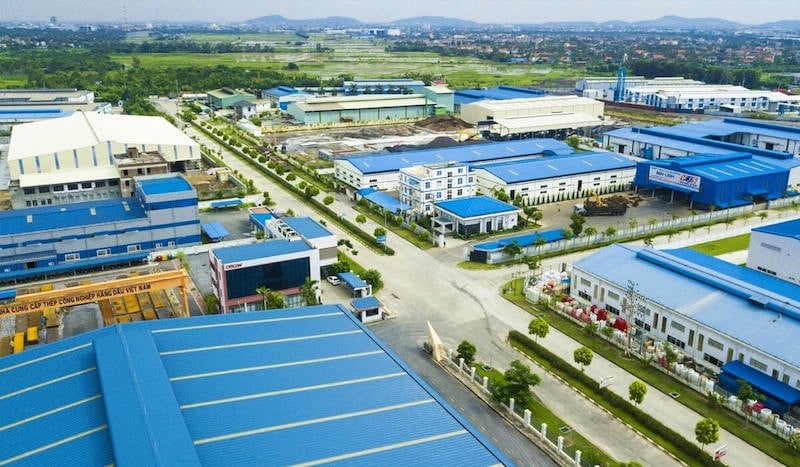
Nam Cau Kien Industrial Park in Hai Phong city, northern Vietnam. Photo courtesy of Shinec.
Pham Hong Diep, chairman of Shinec, pointed out that tenants increasingly seek environmentally friendly factory setups. As part of its commitment to carbon neutrality, Nam Cau Kien IP will implement rooftop solar power systems, allowing tenants to access electricity without relying on the national grid. Furthermore, plans are underway to establish an innovation center and enhance public awareness regarding environmental conservation.