
Indonesia: A Land of Investment Opportunities
Over the past few decades, Indonesia has transformed into a vibrant democracy and has emerged as the largest and most dynamic economy in Southeast Asia. As a member of the G20, the country showcases significant growth potential for foreign investors looking for long-term commitments. With a young workforce and a rapidly expanding middle-class, Indonesia holds the title of the largest economy in ASEAN, making it an attractive investment destination.
The Indonesian government is committed to implementing prudent macroeconomic policies and structural reforms to enhance the ease of doing business. This initiative is part of their support for the New Capital Nusantara project, which includes various tax incentives and an increase in positions available for expatriate workers. This forward-thinking approach is laying the groundwork for a more attractive investment climate.
Several specific trends are driving increases in inbound investment, highlighting Indonesia as a hotbed for global businesses aiming to:
- Diversify their presence in Asia;
- Access ASEAN and South Asia markets;
- Supplement their operations in China; and
- Leverage attractive free trade agreements and business incentives.
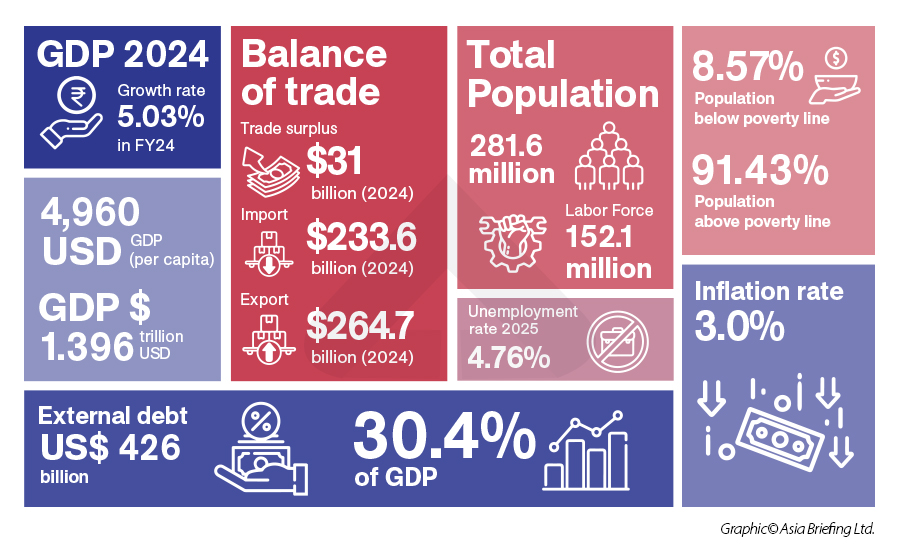
In recent years, many businesses have turned to Indonesia as a second investment option, particularly in consumer-related sectors like retail, health, and financial services. The recent global supply chain challenges and rising labor costs have further positioned Indonesia as a viable alternative in a “China+1” strategy. With a vast labor pool, a burgeoning middle class, and rich natural resources, Indonesia’s economy is projected to grow by 5.03 percent in 2024, slightly less than the previous year, yet continuing to outperform many G20 nations.
For foreign investors, Indonesia presents an immense market ripe for growth, building a strong case for establishing operations in the country.
Ease of Doing Business
Indonesia has made remarkable strides in improving its ease of doing business (EODB) ranking. Recent efforts include implementing regulatory measures aimed at:
- Starting a business—an online platform has streamlined business licensing, issuing electronic certificates.
- Paying taxes—simplified through an online filing and payment system for major taxes.
- Enforcing contracts—now managed via an online case management system for judges to streamline legal processes.
- Trading across borders—enhancements through online processing of export customs for more efficient trade.
- Obtaining electricity—improvements in electrical grids have facilitated business operations.
Indonesia’s International Free Trade and Tax Agreements
Free Trade Agreements
As a member of the Association of Southeast Asian Nations (ASEAN), Indonesia has entered numerous free trade agreements (FTAs) worldwide, including pivotal arrangements such as the ASEAN Free Trade Area and the Regional Comprehensive Economic Partnership (RCEP). These agreements position Indonesia favorably as a catalyst for becoming a global production base.
The ASEAN Free Trade Area, established in 1992, aims to reduce tariffs on goods originating from member countries to 0-5 percent. In addition, Indonesia enjoys trade agreements with countries including Australia, New Zealand, Japan, and South Korea. The RCEP, signed in 2020, stands as the largest FTA, encompassing about 30 percent of global GDP.
Double Tax Avoidance Agreements
Indonesia’s expansive network of 71 double tax agreements (DTAs) significantly benefits foreign investors, eliminating double taxation by providing exemptions or reducing payable taxes in the country. Countries included in these agreements range from Australia to the United States, India, and numerous European states.
Reasons for Companies to Relocate to Indonesia
Ranked as the world’s eighth-largest economy by purchasing power parity (PPP), with a GDP of approximately USD 4.66 trillion, Indonesia is positioned to become the seventh-largest economy by 2030, given its current growth trajectory. The government is dedicated to long-term reforms aimed at enhancing bureaucracy and improving the investment landscape.
In East Asia, Indonesia ranks as the fourth-largest economy by PPP, following China, Japan, and South Korea.
For foreign investors considering relocation, a thorough examination of various factors including infrastructure, talent availability, access to raw materials, incentives, and supply chain logistics is essential. Here are key reasons why companies gravitate toward Indonesia:
- Consistent high growth compared to other low-cost countries.
- Favorable ongoing government business reforms that benefit foreign investors.
- An increasing number of special economic zones with available labor and attractive cost structures.
- A strategic “China plus one” location for companies experiencing rising costs or trade disruptions in China.
Ongoing Business Reforms
Since the enactment of the Omnibus Law in 2020, Indonesia has made continuous refinements to its business regulations. In March 2023, the government passed Law No. 6 of 2023, enhancing the legal framework for reforms. Key updates include the introduction of a risk-based business licensing system through the Online Single Submission platform.
The government will conduct risk assessments on business applicants, categorizing business activities into four risk levels—low, medium-low, medium-high, and high. This new approach simplifies licensing based on assessed risk, allowing businesses with lower risk levels to navigate the bureaucratic landscape more easily.
Incentives, Workforce, and Economic Zones
Incentives for Doing Business in Indonesia
To attract foreign investment, the Indonesian government offers numerous incentives, focusing particularly on tax incentives. Corporations investing in priority sectors can benefit from reduced tax rates and tax holidays. Investment incentives extend to labor-intensive industries, training programs, and research and development activities.
Tax Incentives
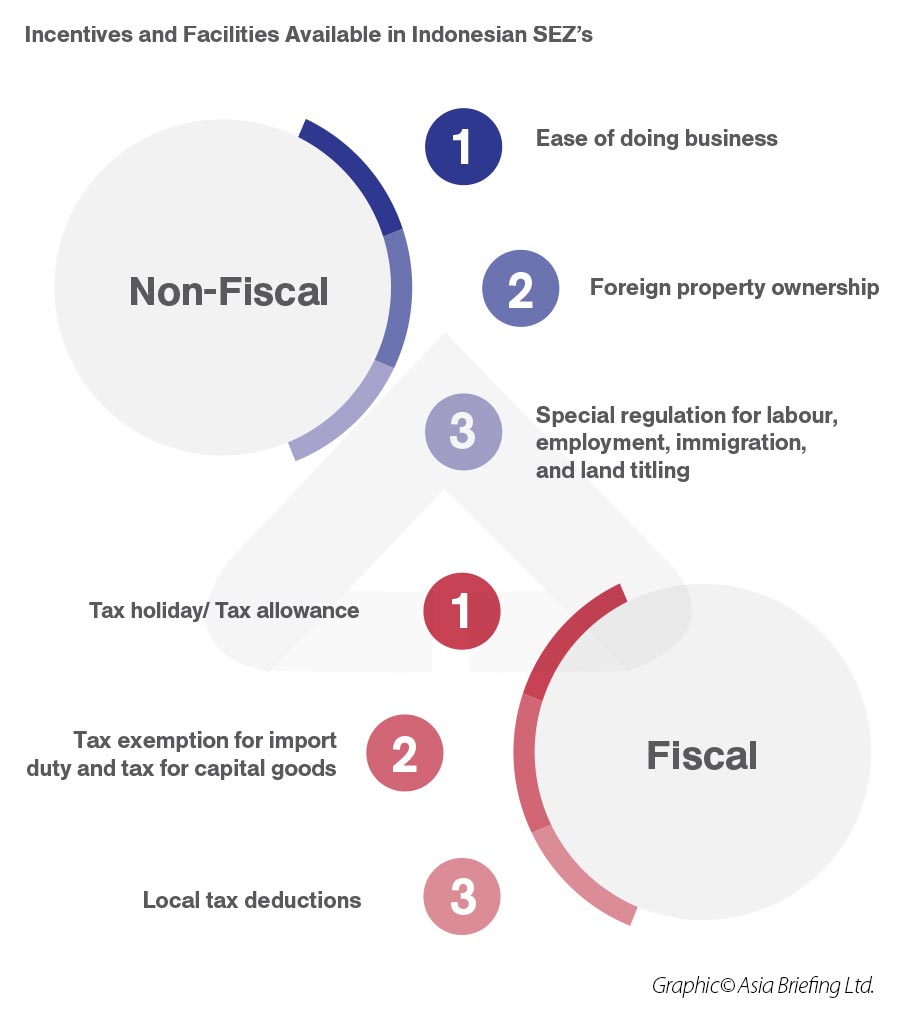
Corporate income tax (CIT) incentives are available to encourage investment. Different priority sectors offer varying exemptions, and special economic zones facilitate advantageous business conditions through corporate tax holidays and exemptions from import duties.
|
Corporate Income Tax Holidays for Special Economic Zones in Indonesia |
||
|
Taxpayer |
Investment Amount |
Concession Period (Years) |
|
Business Entity |
100 billion rupiah (US$7 million) |
10 |
|
Businessperson |
Between 100 billion and 500 billion rupiah (US$7 million – US$35 million) |
10 |
|
Between 500 billion and 1 trillion rupiah (US$35 million – US$70 million) |
15 |
|
|
More than 1 trillion rupiah (US$70 million) |
20 |
|
Special Economic Zones
Indonesia has established special economic zones (SEZs) designed to attract foreign investment and promote industrial activity across the archipelago. Currently, Indonesia hosts 20 SEZs, each equipped with high-quality infrastructure, special tax incentives, streamlined regulations, and expedited work visa processes.
These zones also promote industry clustering, like Batam Island’s digital park and central Java’s automotive SEZ, selected for their access to local resources while catering to specialized industries.
ASEAN’s Largest Labor Market
With a population of 282.4 million, Indonesia stands as the world’s fourth most populous country, averaging an age of 30, with 60 percent under 40. This demographic makes Indonesia ASEAN’s largest labor market, boasting over 130 million workers and ranking fourth in the world. The country excels in labor-intensive manufacturing, especially in garments and textiles.
Despite its vast labor pool, Indonesia faces challenges with only 55 million skilled workers, and productivity levels appear low compared to other ASEAN nations. The government predicts that 100 million skilled workers will be needed by 2030, implementing tax incentives for businesses establishing apprenticeship and training programs.
Natural Resource Availability
Indonesia is rich in natural resources, including coal, gold, nickel, copper, and petroleum. Mining directly contributes to about 10 percent of GDP, alongside significant foreign exchange earnings. Indonesia produces 30 percent of the world’s nickel and houses the world’s second-largest reserve of copper at the Grasberg mine, which also boasts the largest gold reserve globally.
Regional Investment Highlights
Jakarta is a prime investment location, recording significant investment realizations with a robust infrastructure network. Its strategic location offers immense appeal to investors looking to capitalize on Indonesia’s growing economy.
Industries Driving Indonesia’s Economy
Mining and Petroleum
The mining and petroleum sectors have historically been the backbone of Indonesia’s economy, with primary commodities constituting around 60 percent of total exports. Despite efforts to increase value-added production, commodities are expected to dominate exports for the next decade, primarily directed to emerging markets like China and India.
Manufacturing
Indonesia aims to diversify its manufacturing capabilities, shifting from low-value to high-value products. Currently contributing to 20 percent of GDP, the manufacturing sector strives to reach 25 percent by 2030, propelled by policies focusing on key industries such as automotive, chemicals, and electronics.
Indonesia’s manufacturing sector employs approximately 15 percent of the workforce.
Products include food and beverages, textiles, electronics, and automotive sectors, with micro, small, and medium enterprises (MSMEs) representing 99 percent of manufacturers and accounting for two-thirds of total manufacturing employment.
Services
The services sector is the largest job creator in Indonesia, contributing over 49 percent of employment and approximately 45 percent of total GDP. Growth areas include tourism, hospitality, and aviation. Indonesia’s aviation market is one of the fastest-growing globally, expected to see more than 350 million travelers by 2036.
The healthcare industry also presents lucrative opportunities, as the push toward universal healthcare has increased demand for services across the sector.
Agriculture
With agriculture employing one-third of the workforce, this sector remains vital. Small-scale farming and larger commercial plantations produce diverse products, positioning Indonesia toward achieving food self-sufficiency by 2045.
Digital Economy
Indonesia’s digital economy has witnessed exponential growth and is projected to reach USD 130 billion by 2025. With a tech-savvy demographic, the e-commerce sector is poised to drive this growth, presenting opportunities for foreign investment as the government works to build a favorable regulatory environment.
Infrastructure Development
The Indonesian government has initiated significant infrastructure plans, aiming to invest USD 350 billion within the next few years. This includes the development of new airports, transit systems, and roads, essential for enhancing connectivity throughout the regions.
In addition, the construction of the new capital city, Nusantara, is underway, marking a monumental step in Indonesia’s ambitious growth strategies.
Top 10 Reasons to Invest in Indonesia
|
1 |
Strategic Location |
A key gateway to ASEAN and Asia markets. |
|
2 |
Growing Economy |
Consistent GDP growth driven by strong domestic consumption. |
|
3 |
Government Reforms |
Pro-investment reform agenda and attractive incentive schemes. |
|
4 |
Ease of Doing Business |
Improving rankings in global ease of doing business. |
|
5 |
Large, Young Labor Force |
Roughly 137 million workers with a median age below 30. |
|
6 |
Special Economic Zones |
Investment-friendly zones offering substantial incentives. |
|
7 |
Growing Positive Investment List |
Increased foreign investment opportunities across sectors. |
|
8 |
Growing Consumer Spending |
Rapidly expanding middle class and dynamic services sector. |
|
9 |
Network of FTAs |
Access to global markets through extensive trade agreements. |
|
10 |
Abundance of Natural Resources |
Rich reserves of minerals, coal, and other valuable resources. |