
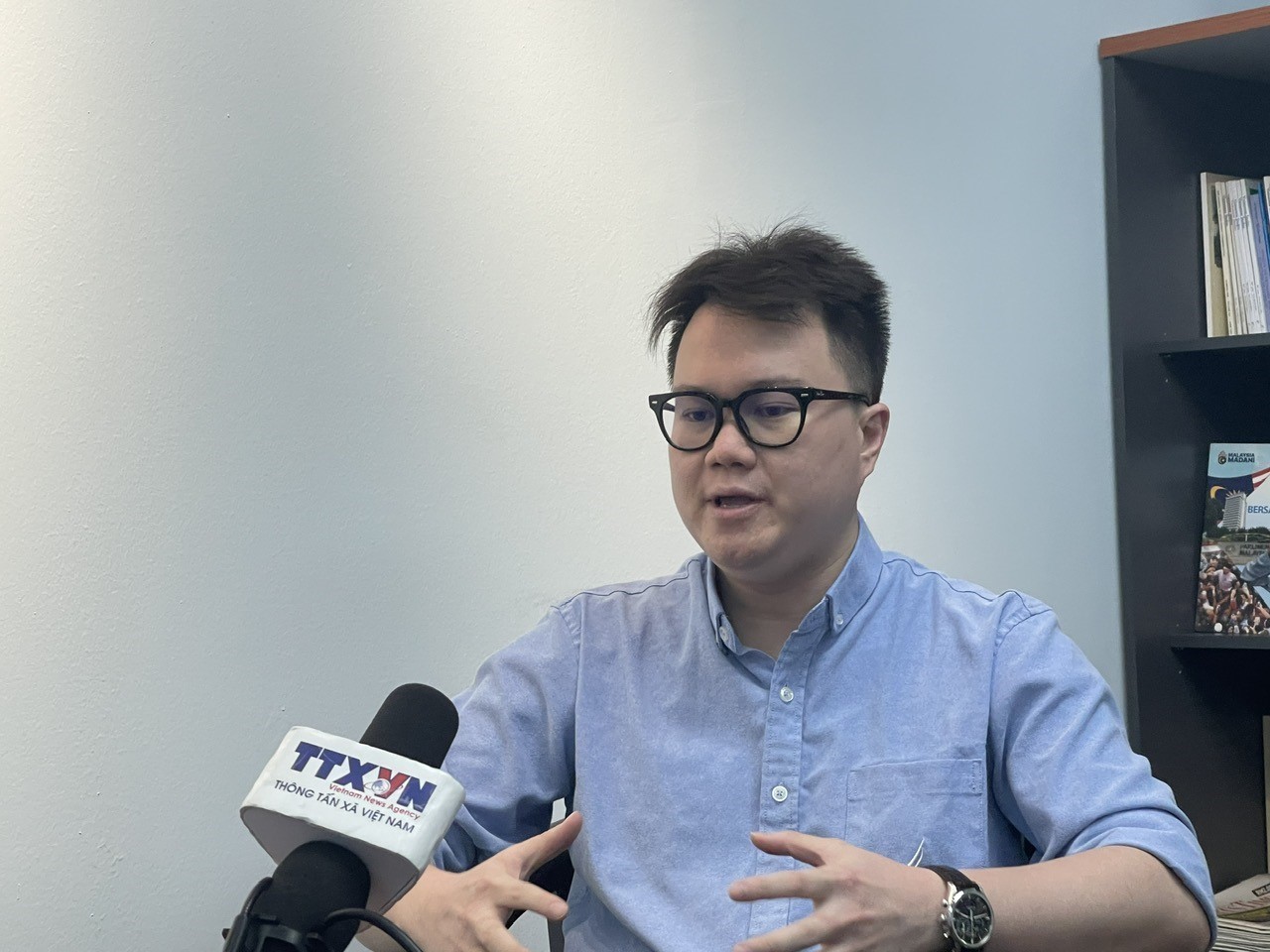
Enzo Sim Hong Jun, a Malaysian researcher specialising in Southeast Asian history and defence, grants an interview to the Vietnam News Agency. Photo: VNA
The 14th National Congress of the Communist Party of Vietnam (CPV) has emerged as a significant milestone, highlighting the internal unity and strategic vision of the CPV leadership. Enzo Sim Hong Jun, a Malaysian expert in Southeast Asian history and defence, underscored the Congress’s role in steering Vietnam toward achieving notable economic advancements and enhancing its global stature.
One notable aspect of the Congress was its shorter duration compared to previous iterations. Jun observed that this choice was indicative of a robust consensus and unity within the Party, rather than merely a logistical adjustment. This streamlined approach was perceived positively by the international community, offering a reassuring message about Vietnam’s political stability, which is increasingly vital for attracting global investment.
Furthermore, the commitment to ensuring a stable leadership and fostering consensus in the aftermath of the Congress stands as a crucial element for advancing Vietnam’s long-term economic objectives over the next five years. The country aims to sustain an impressive annual economic growth rate of approximately 10%. Jun articulated that this ambition reflects a strong dedication to maintaining robust economic conditions in the face of unpredictable global dynamics.
To realize these ambitious growth targets, the Vietnamese leadership is implementing a range of unprecedented administrative reforms. These reforms aim to streamline the state apparatus by reducing the number of ministries and agencies, minimizing staffing levels, and merging various localities to enhance organizational efficiency. Such measures not only contribute to fiscal prudence but also establish a more responsive governance structure.
Moreover, the commitment to combat corruption remains a priority for Party General Secretary To Lam. Jun emphasized that this ongoing effort is vital for rebuilding public trust and creating a transparent environment conducive to attracting foreign direct investment (FDI). As global market conditions shift, ensuring a favorable investment climate is increasingly indispensable for Vietnam’s economic strategies.
Vietnam’s development strategy is also intricately linked to substantial investments in key infrastructure projects. Plans to construct the North–South high-speed railway and upgrade rail links to enhance trade with China reflect a forward-thinking approach to regional connectivity. This investment in infrastructure aims not only to bolster domestic capacity but also to facilitate international trade.
In addition to these transport initiatives, the accelerated development of Long Thanh International Airport aims to enhance Vietnam’s transit capacity and gradually establish the nation as a regional transport hub. By fostering a multimodal transport system that integrates aviation, road, and rail networks, Vietnam is taking significant strides toward enhancing its strategic valuation in the region.
Overall, the 14th National Party Congress has delineated a clear roadmap for Vietnam’s future, focusing on political stability, administrative modernization, robust anti-corruption frameworks, and decisive infrastructure advancements. Jun noted that this multifaceted strategy, combined with a proactive foreign policy, positions Vietnam favorably in a rapidly evolving global landscape where traditional partnerships are becoming less predictable. The strategic foresight illustrated by these initiatives, he concluded, enables Vietnam not only to navigate prevailing challenges but also to assert its rising influence on the global stage.