
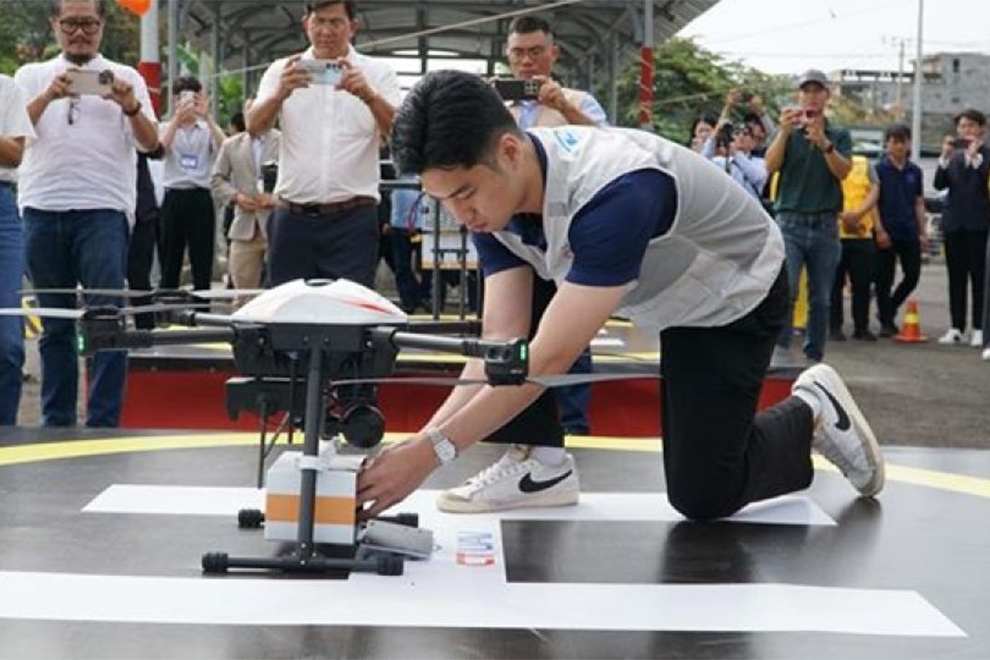
A package being prepared for shipment. PHOTO: VNA/VIET NAM NEWS
HO CHI MINH CITY – In a groundbreaking development, Việt Nam has launched its first cross-sea postal delivery route utilizing an unmanned aerial vehicle (UAV). This initiative marks a significant leap in logistics technology application and reinforces the burgeoning low-altitude economy of the country.
The newly established route connects Cần Giờ Commune and Vũng Tàu Ward in Ho Chi Minh City and was inaugurated on February 12. This achievement is a collaborative effort involving the municipal Department of Science and Technology, CT Group, and Vietnam Post Corporation.
During the inaugural flight, a UAV, designed and manufactured by CT UAV, successfully transported a 2kg parcel over a distance of more than 12 kilometers in approximately 15 minutes. This aerial journey, crossing open sea, is estimated to be six times faster than traditional road transport, and three times quicker than delivery via waterways.
Authorities suggest that implementing UAV technology could cut total travel time between Cần Giờ and Vũng Tàu by 80–90 percent compared to conventional road methods. Once fully operational, the route is anticipated to handle between 3,000 and 5,000 small parcels, each weighing under 2kg, daily from inner Ho Chi Minh City to the Vũng Tàu area. Additionally, the service will address the delivery needs of offshore vessels, with around 120 large ships in the area requiring parcel and document transfers on a daily basis.
The UAVs are equipped with the proprietary CT Nexus Flight Control System. This system enhances wind resistance and ensures stable performances in both coastal and marine conditions. With an average cruising speed of 10–15 meters per second, the UAVs offer operational flexibility tailored to various logistics scenarios.
To guarantee safety and airspace security, specific flight parameters have been established. These include a maximum altitude of 200 meters, a 300-meter-wide flight corridor, and a 500-meter operational radius at take-off and landing zones. Each UAV is fitted with onboard cameras and an intelligent autonomous navigation system. This technology enables the transport of postal items, essential goods, pharmaceuticals, and documents while adhering to operational norms.
Phạm Huỳnh Quang Hiếu, deputy director of the HCM City Department of Science and Technology, emphasized the technical challenges posed by such cross-sea flights. He noted that the longer distance and unpredictable weather conditions necessitate advanced technological solutions.
“This flight showcases not only our technological maturity but also our capacity to effectively organize and implement low-altitude air transport models within real-world contexts, especially given the marine environment,” he stated.
Nguyễn Như Thuận, the director of HCM City Post under Vietnam Post, shared that the corporation plans to continue collaborating with relevant agencies to finalize procedures and operational conditions before gearing up for large-scale commercial services. Currently, this innovative service is yet to be opened for widespread commercial fee collection.
Beyond postal delivery, the potential applications of UAV technology extend to offshore logistics, maritime inspection and monitoring, and even emergency medical assistance at sea. This initiative is paving the way for broader UAV-based services and is crucial for establishing a low-altitude economy, which could act as a new growth driver for Việt Nam.
ANN/Viet Nam News