
By Truong Van
Wed, July 12, 2023 | 8:30 am GMT+7
Vietnam’s industrial real estate sector is undergoing a significant transformation, fueled by increasing interest from domestic and foreign investors. This surge is primarily driven by multinational corporations (MNCs) seeking to diversify their supply chains, especially in the wake of global uncertainties.
The backdrop of this interest is marked by a booming economy and escalating foreign direct investment (FDI). Vietnam achieved nearly $27.72 billion in registered FDI for 2022, with disbursements hitting a five-year high of $22.4 billion—a 13.5% increase compared to the previous year.
Remarkably, Vietnam emerged as Asia’s fastest-growing economy in 2022, recording an impressive growth rate of 8.02%. This performance has helped the country stand out as one of the few economies globally to witness two consecutive years of growth since the onset of the COVID-19 pandemic.
Major players like Apple, Dell, Google, Microsoft, Amkor Technology, and Goertek have strategically moved parts of their supply chains to Vietnam in recent years. The allure of Vietnam can be attributed to numerous factors, including its geographical proximity to China, competitive production costs, and a youthful, well-educated labor pool.
John Campbell, the deputy director and head of industrial services division at Savills Vietnam, remarked that Vietnam’s industrial property market is reaping the benefits of a trend towards global supply chain diversification. He indicated that favorable conditions such as a stable local currency and attractive corporate tax rates further enhance Vietnam’s appeal, particularly under the “China plus one” strategy.
In the northern region, recent reports from Cushman & Wakefield show that the second quarter of this year saw the introduction of 238 hectares of new industrial park (IP) space from two parks in Hung Yen province. This expansion illustrates the region’s sustained attractiveness for investment.
According to Trang Bui, the country director of Cushman & Wakefield Vietnam, the northern provinces continue to see robust investment. Locations such as Quang Ninh and Hai Duong are leading this charge, securing a decisive investment wave.
In terms of net absorption during the second quarter, 179 hectares of industrial land were leased, showcasing a strong demand amidst rising supply.
The prime asking price for industrial land in the north has increased to $120/m2 per lease term, reflecting a 3.8% rise quarter-on-quarter and a notable 9.8% year-on-year increase. This trend underscores the high demand for industrial space in the region.
The ready-built factory segment has also seen significant activity, with nearly 252,000 m2 of new supply emerging from three projects located in Bac Ninh and Vinh Phuc provinces, with over 86% of this space being situated in Vinh Phuc.
Despite the high volume of new supplies, the demand for ready-built factories remains robust, with an estimated absorption of around 84,000 m2. Bac Ninh and Hai Duong are at the forefront of this demand, logging net absorption rates of 28% and 26%, respectively.
The regional occupancy rate for the second quarter stood at 76%, which is a decrease from previous months—down 4 percentage points quarter-on-quarter and 10 percentage points year-on-year, attributed to the influx of new supplies.
The rental rates for ready-built factories in the northern region have remained stable at $4.7/m2/month, showing only a slight increase of 1.7% over the year.
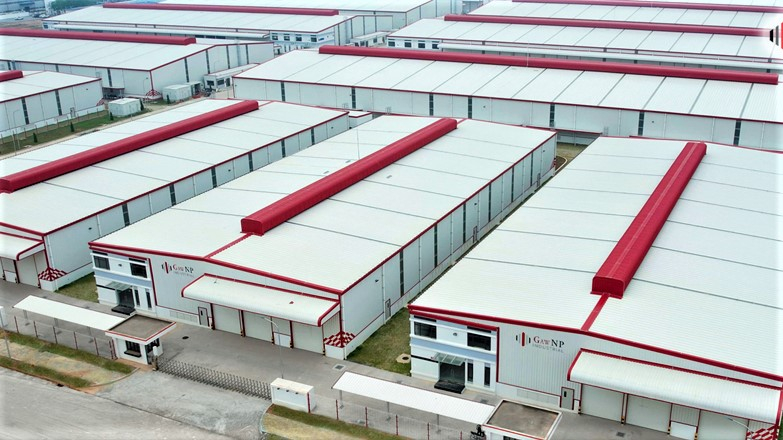
Gaw NP Industrial’s GNP Yen Binh 1 in Thai Nguyen province, northern Vietnam. Photo courtesy of Gaw NP Industrial.
At the end of June 2023, Gaw NP Industrial announced the launch of the GNP Dong Van 3 Industrial Center, located within the Dong Van 3 IP in Ha Nam province, close to Hanoi. This new project spans 16 hectares and focuses on leasing ready-built factories and warehouses.
Scheduled for handover in the fourth quarter, the GNP Dong Van 3 is designed to meet the burgeoning demand from prominent manufacturers in the region, including Honda, YKK, Wistron, Qisda, and Seoul Semiconductor.
This new facility aims to build on the successful models of its predecessors, GNP Nam Dinh Vu and GNP Yen Binh 1 & 2, which have been operational and have contributed to the area’s industrial growth.
More Supply Ahead
To attract further foreign investment, northern provinces are actively working to finalize and announce their master development plans. This proactive approach aims to facilitate more convenient decision-making for foreign investors.
Between 2023 and 2026, nearly 5,000 hectares of industrial land is expected to come to market, signaling an ambitious growth trajectory for the region.
Further enhancing this landscape, the Gia Binh 2 Industrial Park in Bac Ninh, covering 250 hectares, recently broke ground with an estimated investment of VND3.96 trillion ($167 million). The clean ground is expected to be ready by the fourth quarter of 2023.
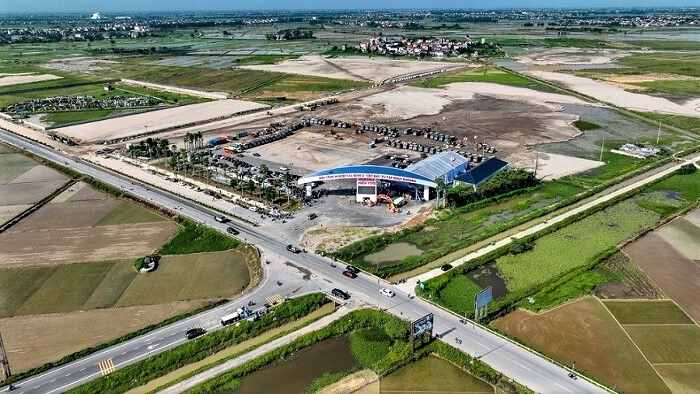
Gia Binh 2 Industrial Park under construction in Bac Ninh province, northern Vietnam. Photo courtesy of Vietnam News Agency.
As reported by Hanaka, this industrial park aims to foster modern and advanced technologies, facilitating economic growth within the Bac Ninh region. Special attention will be given to attracting eco-friendly projects that harness advanced technologies in electronics, IT, and high-tech industries.
Trends Toward Sustainability
Future development trends in Vietnam’s industrial real estate landscape are increasingly leaning towards sustainability. Pham Ngoc Thien Thanh, head of research and consulting at CBRE Vietnam, noted, “While we haven’t seen definitive rental differences in projects certified as ‘green,’ there’s a growing preference for sustainable developments emphasizing renewable energy.”
As of July 2023, numerous industrial projects in Vietnam are pursuing LEED certification—a global standard for environmentally friendly buildings. Notable candidates include Core5 in Hai Phong and projects in Bac Ninh and Binh Duong, demonstrating a clear shift towards sustainable industrial development.
In collaboration with Vietnamese developers, Singapore’s Sembcorp Industries is set to launch five new Vietnam-Singapore Industrial Parks (VSIPs) with an investment of approximately $1 billion. These new parks will feature advanced decarbonization strategies, including rooftop solar systems and green-certified infrastructure, further reinforcing the commitment to sustainable industrial growth.
Such initiatives are expected to promote smart and sustainable park models that focus on minimizing carbon footprints while enhancing operational efficiency through real-time monitoring of energy, water, and resource management.